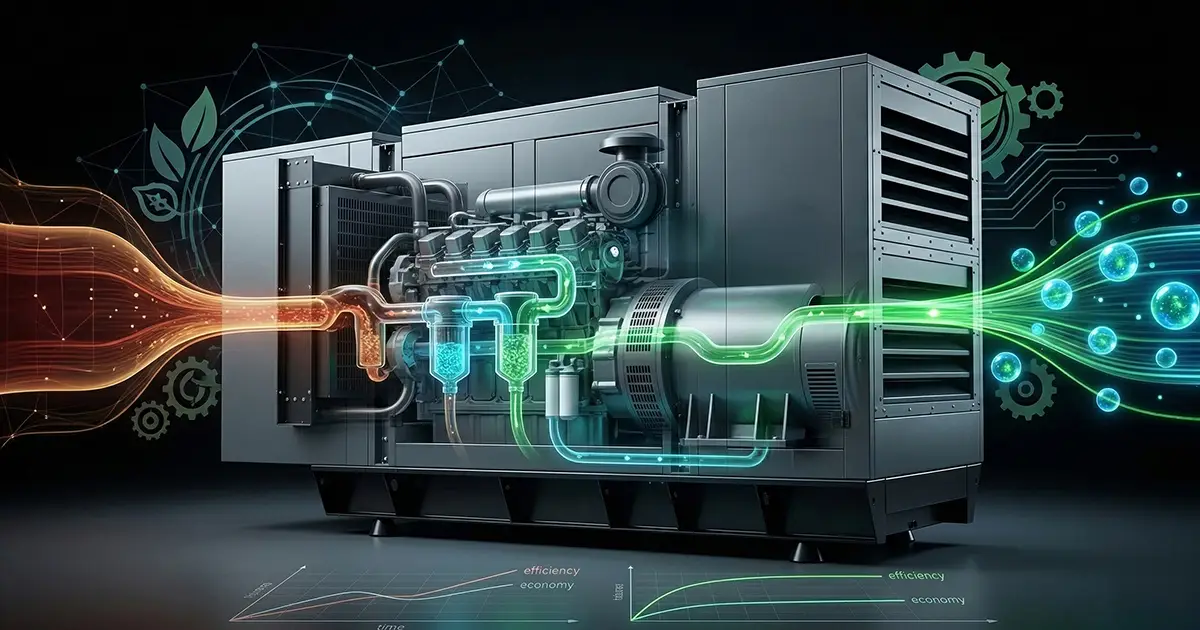
Next-Generation Efficiency Standards in Diesel Generators
60-70% of a generator's total cost of ownership is fuel expenditure. So, is an "efficient engine" alone enough to reduce this cost? Not anymore. For many years, the diesel generator industry focused on "providing uninterrupted power." However, the picture is changing today: as fuel costs rise and emission regulations (Stage V, Tier 4 Final) tighten, customers are no longer just asking if it "works," but rather "how efficiently does it work?" New generation efficiency is not just about the engine's instantaneous consumption value. It refers to a holistic approach that considers parameters such as design compatible with the load profile, partial load performance, auxiliary consumption, control strategy, maintenance regime, and life cycle cost together. In this article, we will summarize why new standards have become a necessity, the technical metrics that determine efficiency, and how this approach is implemented at KJ Power Generator. In the total cost of ownership of a generator set, fuel is the most dominant factor in most scenarios. The critical point is this: a significant portion of generators operate at partial load rather than nominal power. Efficiency loss at partial load grows exponentially with incorrect capacity selection, improper paralleling strategies, or inadequate control algorithms. Industry professionals no longer find the question "is it emission compliant?" sufficient on its own. In addition to standards like Stage V and Tier 4 Final, it is expected that consumption and emission performance on a g/kWh basis must be verifiable. This standardizes the discipline of measurement, reporting, and monitoring. The new generation definition of efficiency includes not only consumption but also dynamic performance criteria such as load step response, voltage/frequency stability, and recovery time. Inefficient operation often has a negative impact on stability and equipment life as well. Specific Fuel Consumption (SFC/BSFC): Shows how much fuel a generator consumes to produce 1 kWh of electricity (g/kWh or L/kWh). It is generally compared at 50%, 75%, and 100% load levels. Partial Load Efficiency: Especially in the 30%-60% band, the characteristic of consumption is of critical importance. Auxiliary Power Consumption: The total energy impact of fans, heaters, charging systems, control panels, and auxiliary pumps. Power Quality and Dynamic Response: Frequency/voltage deviation, recovery time, harmonic performance. Maintenance and Operating Factor: Filter/oil change periods, maintenance accessibility under load, effectiveness of preventive maintenance. The most common efficiency loss we see in the field is selecting a capacity larger than necessary (over-sizing). This situation creates low combustion efficiency at partial load, soot/carbon buildup, increased maintenance needs, and an unnecessary rise in fuel consumption. An efficient generator set is defined by alternator efficiency and system losses as much as engine efficiency. In alternator selection, efficiency class, operating temperature, load character (reactive/inductive load ratio), and harmonic resistance must be correctly interpreted. Modern controllers do not just manage start/stop. Functions such as load sharing, parallel operation, automatic load shedding, keeping within the optimum operating band, preventive failure warnings, and remote monitoring increase continuity while reducing fuel consumption. Especially in multi-generator installations, partial load losses can be significantly reduced with parallel architecture in the right scenarios. New efficiency standards treat emission compliance not as "additional equipment" but as part of system performance. Injection management, turbo efficiency, cooling strategy, and, if necessary, post-exhaust treatment technologies determine both environmental compliance and operational character. Efficiency becomes sustainable not just with catalog data, but with installation quality, commissioning, fuel quality management, periodic testing, load bank verification, and planned maintenance. This is the "hidden" clause of new generation standards: continuity of performance. A high-impact checklist in the field for industry professionals: As KJ Power, we do not reduce efficiency to a single component. We offer the optimum solution for every load profile with Volvo Penta, Perkins, Cummins, Baudouin, and SDEC engine options. Our applications that make a difference: As a manufacturer exporting to more than 120 countries and producing over 7,000 units annually, we deliver systems that work measurably efficiently in the field, not just "work." Diesel generators continue to be the fundamental guarantee of energy continuity. However, today, the cost, performance, and environmental impact of this guarantee are now transparently measured and reported. New Generation Efficiency Standards represent a holistic engineering approach aimed at increasing reliability and sustainability while simultaneously reducing fuel consumption.
Contact us to perform a free efficiency analysis of your current system. [email protected] | +90 444 59 30 | kj.com.tr KJ POWER GENERATORWhy Are "New Generation" Efficiency Standards Needed?
1) Fuel cost is no longer just a budget item, but a competition parameter
2) Emission and sustainability requirements make performance measurement mandatory
3) Energy continuity in critical facilities = efficient and stable dynamic performance
With Which Metrics is Efficiency Measured in Generators Now?
5 Key Components of New Generation Efficiency
1) Correct Sizing
2) Engine-Alternator Matching and System Architecture
3) Intelligent Control Strategies
4) Post-Emission Treatment and Combustion Optimization
5) Life Cycle Approach
What Should Facilities Do in Practice?
KJ Power Generator Approach: Designing Efficiency at the System Level
Conclusion: Efficiency is No Longer a Choice, But a Necessity
Our expert team will report your specific savings potential based on your load profile within 48 hours.
Uninterrupted Power, Superior Performance


