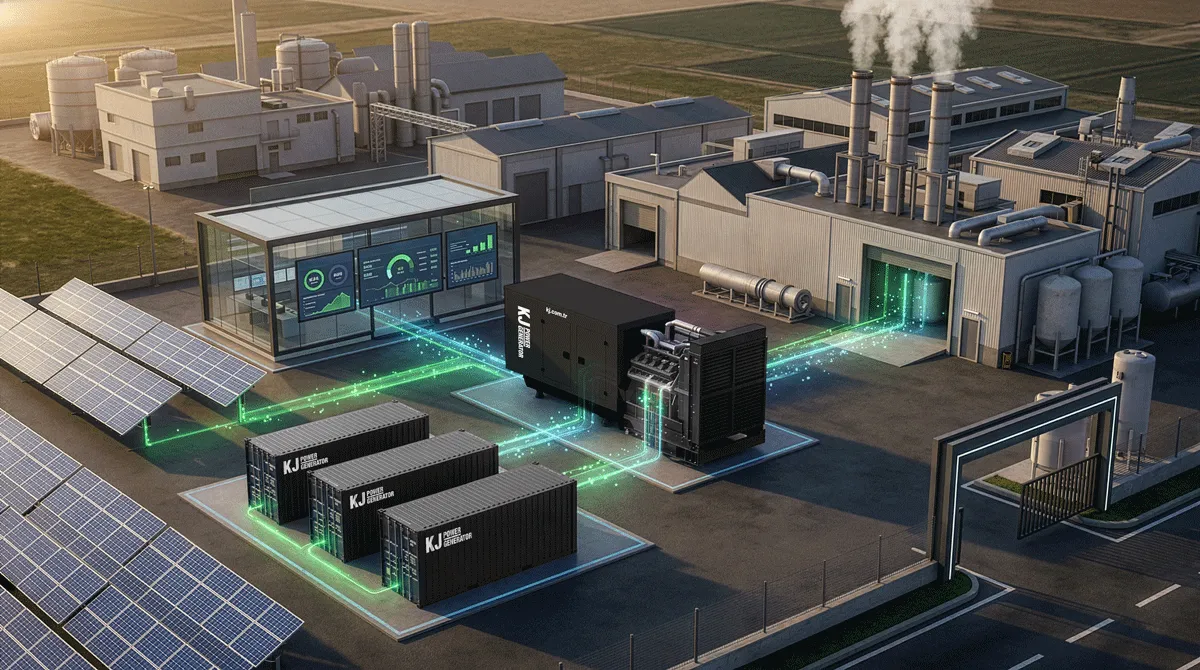
Sustainability is No Longer an Option, but a Fundamental Criterion
For many years, generators were evaluated solely on continuity and reliability under the heading of backup power. Today, the picture is more detailed: carbon intensity, local emission limits (NOx/PM), fuel supply risk, and operational efficiency are all on the table at once.
The critical question for industry professionals is: how can a generator strategy be aligned with sustainability goals without compromising uninterruptible power security?
As KJ Power Generator, our field experience shows us clearly: Sustainability is not just a "green fuel" choice; it requires a holistic re-evaluation of the entire process, from design to operation, from production stances to product packaging, and from maintenance to operational management.
1) Right-Sizing and Operating Profile: Manage the load profile, not the kW
Strategic Analysis
- Partial capacity sizing negatively affects specific fuel consumption, especially in diesel generator sets operating at low loads; exhaust temperatures drop, fuel combustion quality deteriorates, and in some scenarios, issues such as wet stacking (sweating) can occur.
Result: higher fuel consumption, increased maintenance load, and higher emissions. - Load profile is not just average power: parameters such as peak loads, transients, motor starting currents, harmonics, power factor (PF), step load behavior, and cycle counts are the fundamental inputs of a generator strategy.
- The "Standby/Prime/Continuous" classification directly impacts cost and emission results in terms of sustainability: operating the same set under different duty definitions changes everything from maintenance intervals to fuel planning.
Actionable Steps
- Load study + data collection: A real profile is extracted with 2-4 weeks of power analyzer data (kW, kVAr, PF, THD, peak/bottom).
- Right-sizing + modularity: Evaluate modular parallel architecture (N+1 / Required capacity (N) + 1 backup equipment) instead of a single large set; run the smaller set at low loads to stay within the optimum SFC (specific fuel consumption) band.
- Control strategy: Determine load sharing (kW/kVAr droop control or constant frequency load sharing control) and an "optimum load" policy in parallel operation.
- Acceptance tests: During field commissioning, use load bank tests not only for capacity verification but also for emission/thermal behavior and control stability.
As KJ Power Generator, we base our capacity determination process at the start of a project on the time-dependent behavior of the load profile, rather than catalog kVA values. In this way, even at the initial design stage, we create a system architecture that permanently reduces both fuel consumption and maintenance costs.
2) Fuel and Emission Technologies
Strategic Analysis
2a. Sustainability does not end with just choosing the fuel type. Even if the same fuel is used, the way the engine burns, the injection system, air management, and exhaust aftertreatment systems significantly affect emission values. In other words, the real difference is made by how the entire system works together, not the fuel itself.
2b. Diesel: It is a powerful, reliable, and infrastructure-ready solution. However, emission rules are becoming increasingly strict. Therefore, two main approaches stand out:
- Diesel engine + advanced exhaust aftertreatment systems (such as SCR, DPF)
- Diesel engine + lower carbon alternative fuels (e.g., Stage V compliant and HVO)
2c. HVO (Hydrotreated Vegetable Oil): A fuel produced from vegetable and waste-based raw materials that can be used instead of diesel.
- Provides cleaner combustion, particulate formation is lower.
- Can reduce the total carbon footprint.
- Can be used in most diesel engines without major modifications. However, price, supply continuity, and certification of the fuel are important.
2d. Stage V (EU Phase 5) Emission Standard: The European emission standard applicable especially to generators and construction machinery.
- It limits not only the amount of soot but also the number of particles. (PM, PN)
- Therefore, the use of a particulate filter (DPF) is generally required.
- Stage V compliance is an important competitive advantage in terms of both legal obligation and exports.
2e. Hydrogen-ready / Biogas: These are among the future-oriented solutions. However, it is not enough for only the engine to be suitable. Storage, safety, fuel supply, and legal permits must also be taken into account.
Actionable Steps
- Creating a fuel decision matrix: Carbon intensity + local emissions + supply risk + CAPEX/OPEX + maintenance complexity + permit processes.
- Integrate exhaust aftertreatment into system design: Systems like SCR are not just about adding equipment; they should be handled as a whole with heat management, back pressure, sensor calibration, and chemical consumption.
- Perform field verification: Plan for measurement and verification under operational conditions whenever possible, rather than relying on theoretical emission values.
- Fuel quality and storage protocol: Procedures for oxidation stability, filtration, water particle management, and tank hygiene, including alternative fuels, are hidden cost items of sustainability.
As KJ Power Generator, we treat fuel and emission technologies not as a standalone product choice, but as an application-specific engineering matter. We design treatment systems to operate stably under field conditions, integrated with control architecture and maintenance processes.
3) Hybrid Architecture and Microgrid Logic: Think of the generator as an energy system component, not in isolation
Strategic Analysis
- One of the strongest levers in sustainability is hybridization: generator + battery energy storage (BESS) + renewable sources + smart control.
- When generators are operated in their most efficient range, both fuel consumption and emissions improve. BESS stays in the optimum zone by taking over low loads and short-term peak demand (peak shaving).
- Critical issues in Microgrids: islanding scenarios, synchronization, black start capability, frequency/voltage regulation, protection coordination, and power electronics interactions.
- Hybrid systems provide operational benefits not only in terms of carbon footprint, but also in terms of noise, maintenance cycle counts, and fuel logistics (fewer shipments).
Actionable Steps
- Clarify the use case: Peak shaving? Load balancing? Renewable integration? Uninterruptible power?
- Choose a control philosophy: Will the generator be a grid-forming source or an inverter-heavy architecture?
- Parallel panel and protection coordination: ATS (Automatic Transfer Switch), synchronization, protection relays, short-circuit levels, and selectivity analysis become more critical in hybrids.
- Define performance KPIs: gNO₂/kWh, liters/kWh, operating hours, number of starts/stops, maintenance cost/1000 hours, availability %.
For KJ Power Generator, the value of hybrid and microgrid projects comes not from adding hardware, but from the holistic design of the power distribution logic, protection setup, and site-specific commissioning approach that determines how the system will operate from the start.
4) Digitalization and Life Cycle Management: Sustainability requires measurement infrastructure, not just a report
Strategic Analysis
- Sustainability claims are strengthened by auditable data. On the generator side, this is possible through the digitalization of operation and maintenance processes.
- Condition-Based Maintenance (CBM) and predictive maintenance reduce the risk of unplanned downtime while lowering unnecessary parts replacement and service trips; thus, both cost and carbon footprint are reduced.
- Life Cycle Assessment (LCA) perspective is not limited to equipment operation: it covers topics such as production, logistics, maintenance parts, oil/filter waste, overhaul, and second life cycle.
- In terms of Environmental, Social, and Governance (ESG) criteria, generator consumption data for Scope 1 emissions is a fundamental input for GHG (greenhouse gas) calculation processes; if data quality is low, report quality also drops.
Actionable Steps
- Telemetry and data standardization: Fuel consumption, load, PF, alarms, maintenance counters should be placed on a single data model.
- Predictive indicators: Early warning parameters such as cooling water temperature trend, oil pressure fluctuation, battery health, vibration/alternator temperature.
- Circularity plan: Overhaul (remanufacturing), component recovery, oil/filter waste management, and standard environmental procedures in the field.
- Audit trail: Maintenance records, calibration, test reports, and emission verification documentation should be kept as a single compliance package.
- A.I. and Anomaly Detection.
At KJ Power Generator, data generated from field operations and maintenance activities are moved into a verifiable and traceable framework. Thanks to this structure, decisions are made to continuously improve system performance, and sustainability and ESG reporting are supported directly by real field data.
Conclusion: An actionable roadmap (measurable gains within 90 days)
A sustainability-oriented generator strategy is portfolio optimization, not "product selection." The following steps make complex projects manageable:
- First 30 days - Measure, Classify, Target
Measure the load profile and classify applications based on Standby/Prime/Continuous power.
Determine the KPI set: liters/kWh, availability, maintenance cost, gCO₂/kWh (calculable). - 30-60 days - Design, Optimize
Develop right-sizing and modular parallel architecture options.
Select the most suitable combination with a decision matrix for fuel and emission technologies. - 60-90 days - Hybridize, Digitalize, Verify
Evaluate hybrid (BESS + generator) feasibility on a scenario basis.
Standardize telemetry + maintenance processes; launch the verification/test plan.
As KJ Power Generator, we treat sustainability as engineering performance verified by field realities. Right-sizing, the right fuel emission architecture, hybrid system design, and a data-driven maintenance approach—each of these preserves operational reliability while materializing carbon and emission targets.


