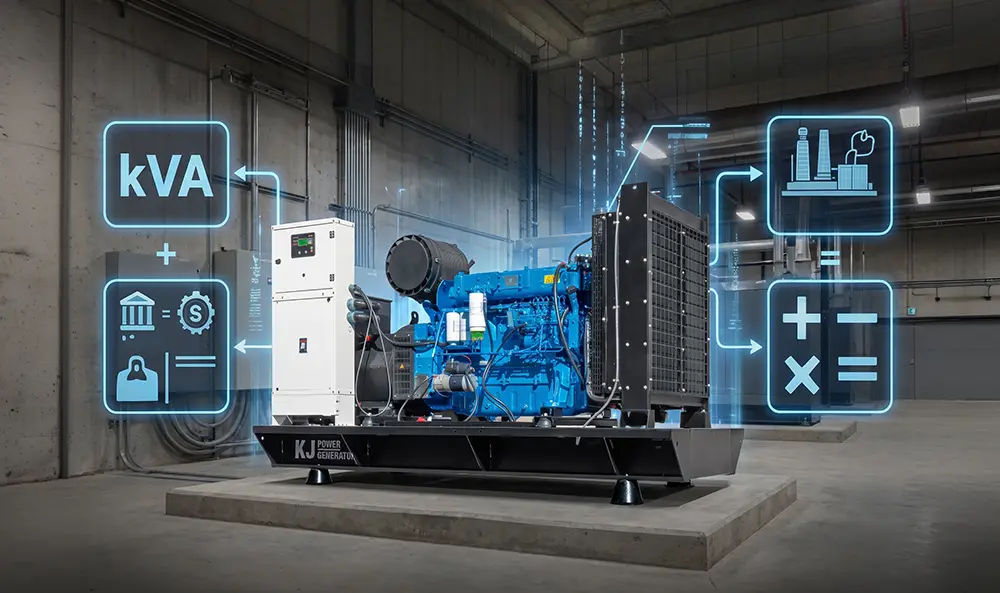
During power outages or in locations where grid electricity is unavailable, the first step toward establishing a reliable power supply is determining the correct generator capacity. Selecting a capacity that is too low or unnecessarily high can directly affect system performance, fuel consumption, investment costs, and equipment lifespan. Therefore, generator capacity calculation should consider factors such as electrical load, the active power of connected equipment, power factor, starting current, instantaneous power demand, and reserve capacity. In this guide, KJ Power Generator explains the key points you need to know for proper generator selection, from determining how many kVA your generator should provide to calculating your overall power requirements.
What Is Generator Capacity and Why Should It Be Selected Correctly?
Generator capacity refers to the electrical load that a generator set can supply under specified operating conditions and is generally expressed in kVA or kW. When selecting the correct generator capacity, simply adding up the rated power of connected devices is not sufficient. Generator load calculations should also take into account the operating characteristics of the loads, simultaneous usage, power factor, and the starting current of motor-driven equipment. If generator power demand is calculated below the actual energy requirement, overload and performance problems may occur. On the other hand, selecting a system that is significantly larger than necessary can negatively affect investment and operating efficiency. For this reason, rated power, maximum power, and the expected load ratio should all be considered when selecting a generator that matches the actual requirement.
What Is kVA? What Does the kVA Rating Mean When Selecting a Generator?
Understanding what kVA means is fundamental to evaluating generator capacity. kVA (kilovolt-amperes) represents the apparent power in an electrical system, while kW (kilowatts) represents usable active power. Therefore, the difference between kVA and kW must be considered, particularly when performing generator kVA calculations. In basic terms, active power is calculated by multiplying apparent power by the power factor, expressed as kW = kVA × power factor. For example, in a system where the power factor is assumed to be 0.8, 100 kVA of apparent power corresponds to 80 kW of active power. However, because the actual power factor may vary depending on load characteristics, generator selection should not rely solely on theoretical conversion. The technical characteristics of the actual loads should also be evaluated.
How Do You Determine How Many kVA of Generator Capacity You Need?
To determine how many kVA of generator capacity you need, the first step is to identify all electrical equipment that will be connected to the generator. Lighting, air conditioners, pumps, motors, elevators, computers, production machinery, and other loads should be assessed to calculate the total power demand of equipment expected to operate simultaneously. The instantaneous power demand and starting current created when motors, compressors, and similar equipment start operating should also be included in the calculation. If the system may expand in the future, an appropriate reserve capacity should be incorporated into the planning process. This approach ensures that generator capacity is determined according to the actual operating scenario of the facility rather than simply relying on the total kW value.
How Is Generator Capacity Calculated?
The first step in understanding how generator power is calculated is identifying the power ratings and operating characteristics of the loads that will be supplied by the generator. During the generator power calculation, loads expected to operate simultaneously are identified, the active power requirement is calculated, and the corresponding kVA value can be determined using the power factor where necessary. For a simplified generator kVA calculation, the formula kVA = kW / power factor can be used. For example, a theoretical active power requirement of 80 kW with a power factor of 0.8 corresponds to approximately 100 kVA of apparent power. However, the final generator capacity calculation should not be based solely on this formula, as factors such as motor starting currents, variable loads, load ratio, environmental conditions, and reserve capacity must also be considered. Particularly in high-power applications, a detailed generator load calculation should be performed to determine the appropriate power capacity.
How Many kVA Does a Generator for a Home Need?
There is no single standard answer to the question of how many kVA a generator for a home requires. The required capacity depends on which appliances need to operate during a power outage. Refrigerators, lighting, televisions, heating systems, air conditioners, water pumps, and other electrical devices should be considered when calculating total energy demand. Motor-driven equipment such as air conditioners and pumps may require significantly more power during startup than during normal operation. Therefore, proper generator selection for residential applications should consider not only total consumption but also starting current and the likelihood of simultaneous operation. Depending on the installation and usage scenario, an appropriately sized single-phase generator or another suitable configuration can provide a reliable power outage solution.
Generator Capacity Selection for Workplaces and Commercial Areas
How many kVA a generator for a workplace requires depends on the size of the business, its field of activity, and the systems that must continue operating during a power outage. When selecting a generator for an office, computers, servers, lighting, security systems, air conditioning, and communication infrastructure are typically among the primary loads. In stores, restaurants, and other commercial facilities, refrigeration systems, pumps, and additional operational equipment may also contribute to the overall generator power demand. Separating critical and non-critical loads can help prevent unnecessary oversizing and support the design of a more efficient backup power system. With KJ Power generator solutions, the actual electrical load and operating scenario of the business can be evaluated to determine the appropriate capacity for a reliable and continuous power solution.
How Is the Correct kVA Capacity Selected for Industrial Applications?
Industrial generator selection requires a more comprehensive technical analysis than residential or small commercial applications. When selecting a generator for a factory or a generator for a construction site, electric motors, pumps, compressors, welding machines, production lines, and other high-power equipment should be evaluated individually. In particular, the starting current generated by large motors can create a short-term but substantial power demand on the generator and should therefore be included in the calculation. The startup sequence of loads, simultaneous operation, power factor, rated power, maximum power, and reserve capacity should also be evaluated to design a system that matches the actual requirements of the facility. KJ Power Generator offers diesel generators for the power requirements of different industries, as well as special project solutions developed according to specific project conditions and energy requirements.
How Does the Choice Between Single-Phase and Three-Phase Generators Affect Capacity?
The choice between a single-phase generator and a three-phase generator depends not only on capacity but also on the electrical configuration of the installation and the equipment being supplied. Single-phase solutions may be suitable for applications dominated by single-phase loads, while commercial or industrial facilities using three-phase motors and high-power equipment may require a three-phase generator. In three-phase systems, distributing loads as evenly as possible across the phases is important for reliable generator operation. Therefore, when selecting generator capacity, the total power requirement should be evaluated together with the phase configuration of the facility, electrical load distribution, and the technical characteristics of the connected equipment.
What Problems Can Incorrect kVA Selection Cause?
Selecting a generator below the required capacity can result in continuous operation at a high load ratio, increase the risk of overload, affect voltage and frequency stability, and prevent connected equipment from performing as expected. Conversely, significantly oversizing a generator can increase initial investment costs and may make efficient operation more difficult in certain applications where the generator operates at low loads for extended periods. Incorrect generator capacity calculation can also negatively affect fuel consumption, maintenance requirements, and overall operating costs. Therefore, proper generator selection should consider actual energy demand, load profile, and operating duration rather than focusing solely on maximum power.
What Should Be Considered When Selecting the Correct Generator Capacity?
To determine the correct generator capacity, the power ratings of connected devices, simultaneous usage, starting currents, phase configuration, and operating periods should first be analyzed. During generator power calculations, an appropriate reserve capacity should also be considered for potential future increases in electrical load. Factors such as ambient temperature, altitude, operating conditions, and whether the generator will be used for standby or continuous power can also influence actual generator performance. For this reason, particularly in commercial and industrial projects, selecting a generator that matches the actual requirement should be based on a professional technical assessment. KJ Power Generator supports reliable and sustainable operation of power systems through project-specific capacity assessment, engineering expertise, and comprehensive after-sales services.


