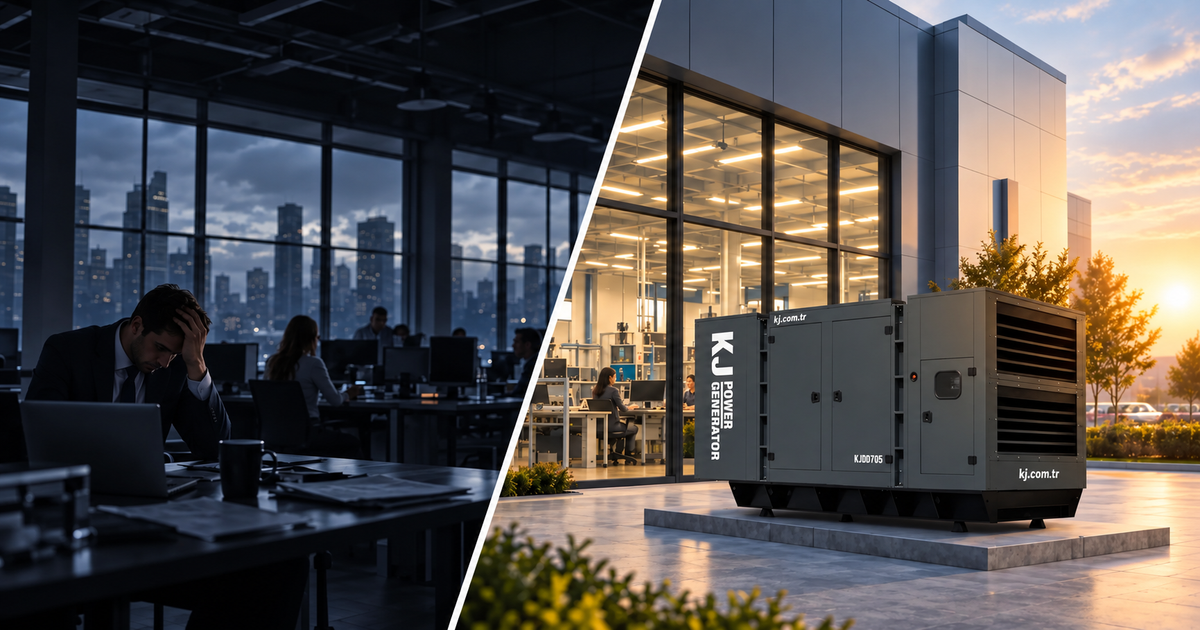
Power outages do not simply mean that electricity is temporarily unavailable for businesses. Many consequences, such as production stoppages, loss of access to digital systems, disruptions to employee workflows, critical equipment becoming unavailable, and interruptions to customer services, can affect a company’s operational and financial performance. Therefore, when assessing the impact of power outages on businesses, attention should not only be paid to the duration of the outage but also to the total potential losses across production, workforce, data, equipment, sales, and customer processes. The cost of power outages for businesses can vary significantly depending on the facility’s field of activity, critical loads, energy requirements, and existing backup power infrastructure. In this article, KJ Power Generator examines the cost of power outages and their impact on businesses, outage-related risks, and power solutions that support business continuity.
Why Should the Impact of Power Outages on Businesses Not Be Underestimated?
The impact of power outages on businesses should be assessed comprehensively because multiple interconnected operational processes can be affected at the same time. Electrically powered production lines, information technology infrastructure, cooling systems, pumps, security systems, communication equipment, and automation systems may become completely or partially unavailable when the power supply is interrupted. The consequences of power outages can occur in various areas, ranging from production and data loss to reduced employee productivity and disruption of customer services. For this reason, business losses caused by power outages are not limited to the direct losses incurred during the period without electricity. The time required to restart operations and return to normal working conditions may also increase the overall cost. Therefore, it is important for businesses to identify their critical operations in relation to power outage risks and integrate a business continuity approach into their energy infrastructure.
How Is the Cost of a Power Outage Calculated?
When calculating the cost of a power outage, both direct and indirect losses should be considered together. Lost production or sales during the outage, the cost of employees who are unable to work, unavailable machinery and equipment, damaged products or raw materials, data and system recovery expenses, and the time required to restart operations can all be included in the total cost. When calculating outage duration costs, a company’s hourly production, service, or revenue capacity can be used as a starting point; however, the actual cost of an energy interruption is more comprehensive. For example, if it takes several hours for production to return to full capacity following a one-hour outage, considering only the period during which electricity was unavailable may not reflect the true loss. Therefore, calculations of operational interruption costs should consider production, personnel, equipment, data, sales, and restart processes together.
How Does Production Loss Increase the Cost of a Power Outage?
Production loss caused by a power outage can be one of the most significant components of the total outage cost, particularly in manufacturing facilities. The shutdown of electrically powered machines, motors, pumps, compressors, conveyors, and automation systems can slow down a production line or bring it to a complete stop. In addition to the volume of products that cannot be produced, interrupted processes, unusable raw materials, and delayed orders may also generate additional costs. When calculating production downtime costs, businesses should consider not only the duration of the outage but also the time required to safely shut down and restart the production line. In factories in particular, the cost of power outages can increase rapidly due to high production volumes and interconnected processes. Using a properly sized diesel generator and an appropriate backup power system to support critical production loads can help limit production losses caused by power outages.
How Much Damage Can Data Loss and System Downtime Cause to Businesses?
As business operations become increasingly dependent on digital systems, the impact of power outages on information technology infrastructure has become increasingly important. During a power outage, unexpected shutdowns of servers, computers, databases, network equipment, or automation software can create a risk of data loss. At the same time, system downtime can disrupt many processes, including order management, production planning, payment transactions, customer services, and internal communication. The cost of power outages in data centers has a different risk profile because service continuity is critical. While UPS systems can provide short-term transition support and protection, generators and other backup energy technologies can be used to meet longer-term energy requirements. Properly designing these systems to operate together helps protect data infrastructure and support service continuity.
How Is Employee Productivity Affected by Power Outages?
Power outages can prevent employees from performing their daily tasks and lead to productivity losses. The inability to use computers, production equipment, lighting, communication infrastructure, internet connections, or HVAC systems may prevent employees from carrying out planned activities even when they are physically present at the workplace. In manufacturing facilities, employees may need to wait for machinery to restart, while in office environments, interrupted access to digital systems can slow down workflows. Additional time may also be required after an outage to complete unfinished tasks and restore normal working conditions. Therefore, employee productivity loss is one of the indirect costs that should be considered when calculating the cost of power outages for businesses.
Power Outage Risks for Machinery, Equipment, and Operational Processes
The impact of power outages on machinery and equipment can vary depending on the technologies used by the facility and the operating characteristics of its processes. A sudden loss of power while production is in progress may cause certain processes to stop midway, automation systems to become unavailable, or machinery to shut down without following a controlled shutdown procedure. In addition to creating machine downtime costs, this situation should also be evaluated in terms of the risk of equipment failure depending on the application. Energy continuity is particularly important for pumps, cooling systems, production lines, control systems, and other critical equipment that must operate continuously. The time required to inspect equipment and restart production systems after an outage can place an additional burden on operational interruption costs. Identifying critical loads in advance and establishing an appropriate backup power infrastructure can help manage these risks.
How Are Customer Satisfaction and Reputation Affected by Power Outages?
The effects of a power outage can extend beyond a company’s internal operations and directly affect customers. Production stoppages, delays in preparing orders, unavailable payment systems, or loss of access to digital services can result in service interruptions. This may lead to reduced customer satisfaction, delivery delays, and, depending on the nature of the business, lost sales. Particularly in sectors where service continuity is a fundamental customer expectation, repeated outages can also create long-term reputational risks. Therefore, ensuring energy continuity is not only about protecting production or technical infrastructure; it is also important for maintaining the customer experience and the company’s ability to continue delivering its services.
How Do Power Outage Costs Vary by Industry?
Power outage costs vary significantly across industries depending on the level of dependence on electricity and the critical processes affected during an outage. In factories, the cost of a power outage can be evaluated based on production line stoppages, machine downtime, interrupted processes, and disruptions to production schedules. In hospitals, power outage risks have a different level of importance due to the need to maintain energy continuity for medical devices, intensive care systems, operating rooms, laboratories, and other critical healthcare infrastructure. In data centers, the cost of a power outage can be assessed in terms of interruptions to servers, storage and network infrastructure, and the availability of digital services, while in retail businesses, outages can affect payment systems, lighting, cooling, security systems, and sales operations. Therefore, rather than applying the same power solution to every business, energy continuity should be planned according to the operating conditions, critical loads, and acceptable outage duration of each industry.
What Measures Should Businesses Take Against Power Outages?
Comprehensive business continuity planning forms the foundation of measures that can be taken against power outages. As a first step, businesses should identify the critical loads that must continue operating during an outage and analyse the power requirements of production equipment, information technology systems, security infrastructure, pumps, cooling systems, communication equipment, and other critical devices. The duration of potential outages, starting currents of loads, simultaneous operating conditions, power factor, and future capacity requirements of the facility should then be evaluated to design an appropriate backup power system. The coordinated operation of different technologies such as automatic transfer systems, UPS solutions, and generators can help support the energy continuity of critical systems following a grid outage. In a generator-based outage protection strategy, it is important not only to install the system but also to perform periodic maintenance and testing.
How Can Uninterruptible Power Solutions Reduce Business Costs?
A properly planned uninterruptible power solution can help limit losses caused by production, service, workforce, and system downtime by enabling critical operations to continue during a power outage. Depending on the company’s energy requirements and operating conditions, diesel generator systems, UPS solutions, battery energy storage systems, and hybrid power systems that combine multiple energy sources can be considered. The appropriate technology or system combination should be determined based on the load profile, required power capacity, operating duration, facility conditions, and whether the application requires backup or continuous power. This approach can support business continuity while also helping prevent investment and operating costs associated with selecting systems that are either oversized or insufficient for the application. KJ Power Generator contributes to the development of reliable and sustainable energy infrastructures for businesses through power solutions designed for the energy requirements of different industries and a project-specific engineering approach.


