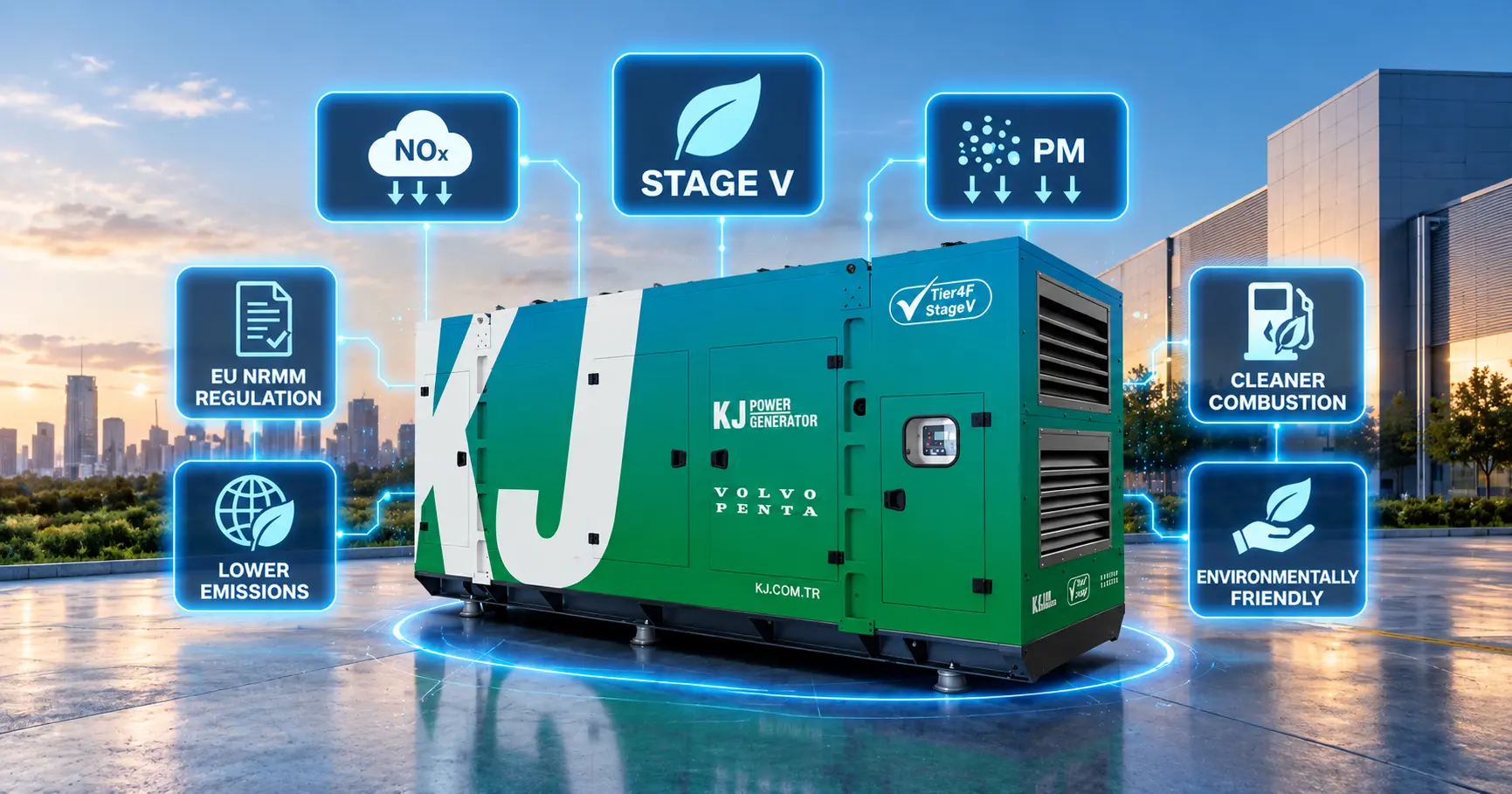
Stage V emission standards are among the European emission standards developed to reduce the environmental impact of internal combustion engines used in non-road mobile machinery. Questions such as what is Stage V and what is the Stage V emission standard are particularly important for businesses using generators, construction equipment and machines classified as non-road mobile machinery. The Stage V emission regulation supports the use of more advanced engine technology and exhaust after-treatment system solutions within the scope of NRMM emission standards, while also contributing to the wider adoption of low-emission generators, environmentally friendly generators and emission-compliant generator solutions.
What Are Stage V Emission Standards?
Stage V emission standards are regulations introduced by the European Union to limit pollutants emitted into the environment by internal combustion engines used in non-road mobile machinery. Under EU Stage V standards, specific limits are applied to pollutants such as carbon monoxide, hydrocarbons, NOx emissions and particulate matter emissions according to engine category and power range. Therefore, the question of what the Stage V emission standard is can be answered as a regulation within European emission standards that sets stricter emission limits for non-road engines and encourages the use of modern engine technology.
Which Engines Are Covered by Stage V Emission Standards?
Stage V emission standards generally cover internal combustion engines used in non-road mobile machinery. Equipment classified internationally as non-road mobile machinery includes construction machinery, agricultural equipment, various industrial machines and certain engine systems used for power generation. When determining Stage V engine requirements, factors such as engine power range, fuel type, intended use and the relevant engine category are taken into account. Therefore, when assessing diesel engine emission standards and generator emission standards, the technical specifications of the engine and the emission requirements applicable to the intended application should be evaluated together.
Differences Between Stage V and Previous Emission Standards
European emission standards have gradually become stricter through stages such as Stage I, Stage II, Stage III, Stage IV and Stage V. One of the important differences between Stage V and previous standards is that, for certain engine categories, particle number is limited in addition to particulate matter emissions. This development has introduced a more advanced level of emission control in terms of diesel engine emission standards and has encouraged wider use of technologies such as DPF systems, SCR systems and advanced exhaust after-treatment systems. As a result, engine manufacturers have moved toward developing more advanced solutions to reduce both NOx emissions and particulate matter emissions.
Why Is Stage V Compliance Important for Generators?
Stage V compliance in generators is particularly important for systems used in the European Union market or in projects where specific emission levels are required by technical specifications. Stage V compliant generator solutions help meet the applicable emission limits for the relevant engine category while also contributing to lower exhaust emissions in urban projects, construction sites and working environments with high levels of human activity. The Stage V generators offered by KJ Power can be considered for projects requiring low-emission generators and emission-compliant generator solutions in line with current generator emission standards.
The Impact of Stage V Standards on Diesel Generators
Stage V standards can affect not only the engine used in Stage V diesel generator systems but also the exhaust line, control system, cooling infrastructure and overall engineering design of the generator set. In applications using a Stage V engine, exhaust after-treatment technologies such as DPF systems, SCR systems and AdBlue usage may be required depending on the engine configuration. These systems directly affect diesel generator emission values, while also making it necessary to evaluate criteria such as fuel efficiency, maintenance requirements, operating load and engine technology when selecting a generator.
How Are Particulate Matter and NOx Emissions Limited Under Stage V?
Under Stage V emission standards, particulate matter emissions and NOx emissions are controlled through different engine technologies and exhaust after-treatment system solutions. A DPF system helps reduce the amount of particulate matter released into the atmosphere by filtering solid particles from the exhaust gas, while an SCR system is used to reduce nitrogen oxides. In some engines equipped with SCR systems, AdBlue usage helps lower NOx components in the exhaust gases. These technologies play an important role in meeting modern diesel engine emission standards and achieving lower exhaust emission levels.
What Should Be Considered When Choosing a Stage V Compliant Generator?
When selecting a Stage V compliant generator, attention should be paid not only to emission levels but also to the actual power requirement, operating duration, load profile, engine technology, fuel efficiency and maintenance requirements of the generator. A generator that is oversized may operate for long periods under low load, creating unsuitable operating conditions in terms of both efficiency and exhaust after-treatment system performance. For construction sites, events and various field applications where portability is required, mobile generators should be evaluated together with generator environmental impacts, noise levels and the applicable generator emission standards.
Stage V Requirements for Construction Sites, Events and Industrial Applications
Construction site generator emission standards, event generator emission standards and industrial generator emissions should be evaluated according to the legislation of the country where the generator will be used, the engine category of the equipment and the project specification. In some projects within European Union countries, NRMM emission standards and EU Stage V standards may become important technical criteria. As the demand for low-emission generators increases at construction sites, outdoor events and temporary industrial power applications, Stage V generator solutions become more prominent, while rental solutions can be considered for short-term or temporary power requirements.
What Are the Environmental Advantages of Stage V Emission Standards?
The main environmental advantage of Stage V emission standards is their contribution to reducing particulate matter emissions, NOx emissions and other harmful exhaust emission components produced by engines used in non-road machinery. The use of low-emission generators and environmentally friendly generator solutions can help protect local air quality, particularly in city centres, busy construction sites and applications where people are located close to operating generators. New-generation engine technology can also provide advantages in terms of fuel efficiency through more precise combustion control and advanced fuel management; however, generator environmental impacts should also be assessed by considering fuel consumption, operating duration and actual load conditions.
Who Are Stage V Compliant Generator Solutions Suitable For?
Stage V compliant generator solutions may be suitable for construction companies, rental companies, event organisers, infrastructure contractors and industrial businesses operating in the European market and required to meet current emission requirements. When selecting a Stage V generator or Stage V diesel generator, the country where the project is located, applicable European emission standards, operating duration, power requirements, diesel generator emission values and operating conditions should be evaluated together. Choosing an emission-compliant generator can contribute to meeting technical specifications in projects with low-emission requirements and to achieving more controlled generator environmental impacts.


