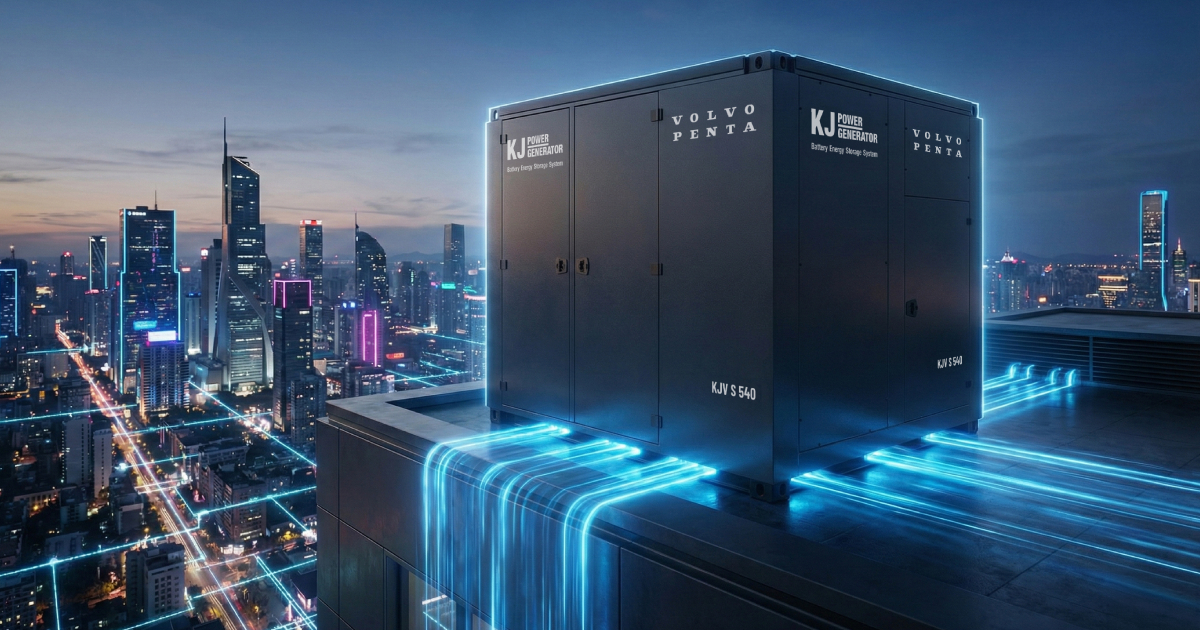
2026 Trends, Generator Market Dynamics, and the KJ Power Generator Perspective
The big picture at the start of 2026: Electricity demand is rising, grids are becoming more complex, and resilience is no longer just an engineering topic; it is now a core KPI for business continuity.
Projections by the International Energy Agency (IEA) indicate that global electricity consumption will reach a new peak in 2026 (above 29,000 TWh), driven primarily by industry, cooling, data centers, and electrification. The same IEA framework emphasizes that renewables may overtake coal in the 2025–2026 period and highlights the critical importance of “grid + storage + flexibility” investments for system security.
This landscape brings three key concepts to the forefront of the generator and energy solutions world: sustainability, digitalization, and flexibility. We can interpret the main trends of 2026 and the growth dynamics of the generator market along these three axes.
1) Sustainability: Emissions compliance and carbon optimization
Sustainability is no longer just about regulatory compliance; it is a competitive factor that directly affects total cost of ownership (TCO) and brand risk.
- Tighter emission standards and low-carbon fuels: In Europe-centered supply chains and project specifications, standards such as Stage V / Tier 4f, fuel flexibility (e.g. HVO compatibility), and reportable environmental performance are increasingly required.
- Fuel efficiency and hybridization: The focus is no longer only on “higher kVA,” but on solutions that manage load profiles accurately, operate efficiently at partial loads, and are supported by energy storage through hybrid architectures. This approach reduces fuel consumption and emissions while also optimizing service and operating costs.
2) Digitalization: The generator is no longer just a “machine,” but a data-producing asset
In 2026, the generator market is clearly splitting into two segments: those that only produce power, and those that convert power into data and manage it.
For corporate customers, the new standard includes remote monitoring, proactive maintenance, fault prediction, fast spare parts and service organization, and transparent reporting. Especially for multi-site operations (mining, industry, logistics, healthcare, data centers, etc.), this dramatically reduces outage risk.
At KJ Power Generator, our approach in this area is to ensure end-to-end process management through our in-house developed CRM/ERP infrastructure, and to make this tangible through solutions such as a digital portal where customers can access product data, warranty information, and maintenance history.
With our “All About Me” application and our ISO 27001 information security focus, field-level digitalization is carried out within a secure, traceable, and auditable framework.
3) Supply chain and critical minerals: The new bottleneck of the energy transition
In 2026, the energy transition is not only a matter of technology; it is also a matter of mining, refining, logistics, and geopolitics.
Reuters analyses from January 2026 highlight that Europe is struggling in the race for capacity and investment in critical minerals (such as lithium and rare earths), creating supply dependency risks. At the same time, changes in China’s tax incentives for battery exports and volatility in lithium prices add a new layer to the cost and supply equation.
The result: In 2026, the right solution will not be just “the best product,” but the right combination of the right product + the right stock + the right service organization + the right alternative scenarios.
4) Why is the generator market growing in 2026?
The key drivers accelerating market growth are becoming increasingly clear:
- Grid reliability concerns and decreasing tolerance for outages
- Data centers and AI infrastructure: New investments are turning “access to energy” into a key location selection criterion.
- Industrial, mining, construction, healthcare, and infrastructure projects
- New use cases enabled by microgrids and hybrid solutions
While different reports present different figures depending on scope, the common denominator is steady growth. This growth means increasing demand not only for “traditional” generators, but for smarter, cleaner, and more integrated solutions.
The gradual tightening of environmental regulations and the rapid expansion of energy storage (BESS) and hybrid solutions are creating downward pressure on the diesel generator segment. Therefore, in the 2026–2030 period, it is not yet clear how much share hybrid/BESS solutions will “cannibalize” from diesel generator sales. The impact may vary across scenarios depending on incentives, total cost of ownership (TCO), fuel prices, and grid reliability.
How is KJ Power Generator positioned in its 2026 vision?
Exactly at the intersection of these three axes: global scale + sustainable technology + digital service orientation.
- Global strength and manufacturing capability: Coverage in 120+ countries, 250+ employees, 30+ engineers; a 30,000 m² modern facility and 30 years of know-how
- Broad portfolio and new energy focus: A product range from 10 kVA to 5000 kVA; diesel generators, gasoline and natural gas generators, lighting towers, hybrid systems, and a strong focus on BESS.
- Digital and transparent after-sales: 24/7 online support and a 360° service approach; accelerating customer experience through digital portals and applications.
- Progress toward global standards: Steps such as inclusion in the Turquality program in Q4 2025 and the target of UL certification in Q1 2026 send strong signals of raising standards in global markets.
- Long-term direction: The vision of “not just being a generator manufacturer, but a company operating in different business lines within the energy sector” points to strategic expansion from a 2030 perspective.
At KJ Power Generator, we approach the growing market in 2026 not with a volume-driven mindset, but with a quality-focused one. We achieve sustainable growth through cleaner, more digital, and more integrated solutions.


